
Letter from the trustees · 12 April 2026
Sunday Doors at ten: what we have learned, and what we got wrong.
From the trustees of Arnold Relief in Need · · 9 min read
Ten years ago this month, on a wet Sunday afternoon in March 2014, two of our trustees walked from the back gate of Arnot Hill House up to a small terrace on Killisick Road and knocked on a front door. They had been talking, for the previous six months, about whether there was anything the trust could usefully do beyond the cheque-writing it had quietly done for fifty years. Their answer, that afternoon, was a kettle, a kitchen table, and an old woman called Mrs Greaves who had not had a visitor since New Year.
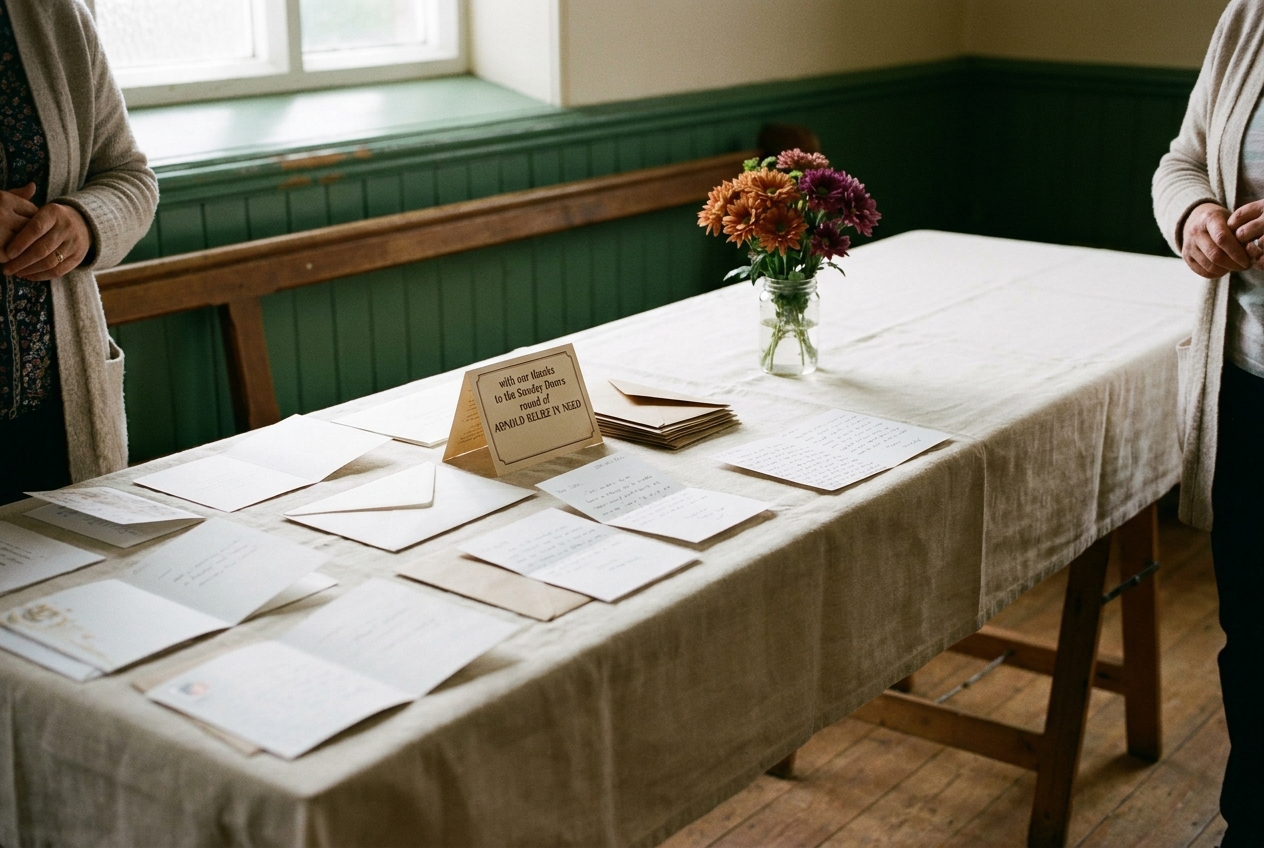
Mrs Greaves is not with us anymore — she died, peacefully, in 2019 — but the round that began at her front door has now visited sixty-four older neighbours, has involved eighteen pairs of befrienders, and has run continuously, every other Sunday, for ten years. On the third Sunday of last month, in the back of St Mary's parish hall, the trust held a small tea for the people who have walked it. There were thirty-two of them. Several had walked it for the full decade. We laid out the cards we have received over the years along the trestle tables, and we tried to add up what we had learned.
This is, in eight short sections, that small addition.
1. The visit is the thing.
When we set out, we had imagined a kind of light surveillance — a befriender would visit and report, and the trustees would, where appropriate, follow up with a grant. In practice, the visit itself has done most of the work. Of the sixty-four households we now visit, only a small handful have ever received a Winter Doorstep or Quiet Repair grant on top of the standing fortnightly visit. The visit, the kettle, the paying of attention — these are most of the relief most of the time.
2. Pair them.
For the first two years we sent befrienders out alone. There were one or two awkward moments — a befriender misjudged a household and was made unwelcome; a household, after some months, became uneasy with a single visitor; a befriender, on the eve of a hospital stay, had no one to hand over to. From 2016 onwards we have paired every befriender with a co-befriender on the same two doors, alternating fortnightly. It has not removed every awkward moment but it has, in practice, kept the relationships in the round even when an individual partnership has lapsed.
'I had stopped opening the post. They came in and sat with it. It is the smallest thing — and the largest thing, both.'
— Margaret, 78, Killisick, on the round she has been visited by since 2023.
3. We had the safeguarding wrong, for too long.
In the early years we ran the round under a single sheet of trustee-written guidance and a casual handshake about DBS. We tightened it, properly, in 2018, after a near miss with a household where a befriender had — entirely innocently — handed over a bank-card PIN. We now require an in-date enhanced DBS check for every befriender; a written safeguarding policy reviewed annually by the named safeguarding trustee; and a standing instruction that no befriender ever handles a household's bank card, cash, or signing power. The lesson is mostly that small charities cannot indefinitely be informal about this, however small and local they are.
4. Saturday surgeries did not work.
We have written about this elsewhere, but it is worth repeating because the lesson has applied beyond Sunday Doors. Between 2017 and 2019 we ran a parallel Saturday-morning walk-in surgery at the back of Daybrook parish hall. We had hoped it would draw in a wider set of households than the doorstep model. Instead it drew in mostly out-of-parish enquirers and embarrassed the few in-parish households who came — who told us, afterwards, that sitting in a queue was the part they had been trying to avoid. We closed it in October 2019.
5. The average partnership is now 4.2 years.
When we started, we assumed visits would shake out to perhaps a year or two before a household moved on. The actual average across the ten-year cohort is 4.2 years. We have one partnership that has run continuously for eight years, with two changes of befriender along the way. The point is not that long partnerships are inherently virtuous; the point is that this is a slow, accumulating piece of work and the trust should expect to be in any given household for some years rather than some weeks.
6. We have lost twelve people across the round.
Across the decade, twelve of the households we visited have passed away while still in the round. In several cases the befriender was the last regular visitor, and in two cases they were named in the order of service at the funeral. We do not always know how to write about this. We have learned, slowly, that the round must accommodate grief — for the household, for the befriender, and for the chair, who often signs the card from the trust.
7. We have not grown, and we do not intend to.
Sunday Doors has plateaued at sixty-four households for the last four years. The trustees have, more than once, looked at expansion — there is no shortage of parish workers who would suggest more names. We have, each time, decided not to. The round works because the chair and the secretary can hold the names of every household and every befriender in their heads at once; we suspect, strongly, that doubling the round would change what the round is. We would rather know sixty-four households well than count a hundred and twenty we never met.
8. The next ten years.
We have no manifesto. We will keep the round at roughly its current size. We will keep pairing befrienders. We will keep the safeguarding policy under review. We will keep the kettle on. We will keep, in particular, a habit we slipped into about year three and have come, gently, to value: when a befriender visits, they take with them no information about the household — no grant history, no family tree — that the household themselves did not put there in the previous visit. The round renews its own knowledge. The trust learns each household the way a neighbour does, in increments.
Our thanks, sincerely, to the thirty-two people who walked across town on a wet Sunday in March 2026 to drink tea with us, and to everyone who has knocked on a Killisick or Daybrook or Woodthorpe door since 2014. The round is yours.
— The trustees of Arnold Relief in Need, signed at the quarterly meeting of 12 April 2026.